


SizingtheAIDemandinIndia
FromTrainingtoInference,WhereWilltheComputeDemandinIndiaComeFrom?
 6th April, 20268 Min Read

 Insight 1
Artificial intelligence is the most consequential technology shift of our time. Generative AI alone could add $2.6 to $4.4 trillion in annual value globally, a figure comparable to the UK's entire GDP, rising to $6.1 to $7.9 trillion when broader productivity effects are included¹. What makes this moment different is the pace of capability gains. In February 2026, ChatGPT crossed 900 million weekly active users, more than doubling from 400 million a year earlier². Models now write production-grade code, reason through multi-step problems, and hold conversations rivalling domain experts.
India sits at the centre of this shift. With over a billion internet users, the world's third-largest startup ecosystem, and a deep base of engineering talent, the country is both a major consumer and an emerging producer of AI. The real opportunity, though, lies not in who trains the biggest model but in who can serve a billion users affordably. This article sizes that compute demand across three dimensions: training, fine-tuning, and inference.
Insight 2AI compute demand falls into three distinct workloads, each with different hardware requirements, cost profiles, and relevance to India.
2.1Training a frontier foundation model is the most capital-intensive activity in AI. Meta's Llama 3 404B required approximately 6.4 million H100 GPU-hours across 24,576 GPUs³; OpenAI's GPT-4 reportedly cost over $100 million to train. This capital intensity is why frontier training remains concentrated in the United States, with global AI data centre capex projected at $400 to $450 billion in 2026⁴. India has not yet matched this scale, but multiple sovereign initiatives signal intent, such as Sarvam AI's 105B-parameter model & IIT Bombay's BharatGen Param2 supporting 22 scheduled languages.
India does not need to out train the big models of the world. The strategic value of Indian sovereign models lies in language coverage, regulatory compliance, and cost control for downstream inference. A 30B model that understands Hindi, Tamil, and Marathi at native quality is more valuable to India's economy than a 400B model that only excels in English.
2.2Most Indian organisations today consume AI through APIs from frontier providers. This works for experimentation, but three constraints emerge at scale: economics (API costs scale linearly; self-hosting a fine-tuned model can reduce cost per token by 3 to 10x), data sovereignty (India's DPDP Act empowers the government to restrict cross-border data transfers, with BFSI and healthcare facing additional compliance requirements), and security (defence and financial services require data to remain within their infrastructure boundary).
47% of Indian enterprises have multiple GenAI use cases in production, yet over 95% allocate less than 20% of their IT budgets to AI⁹. This gap between adoption enthusiasm and budget commitment is the defining tension of India's enterprise AI market today. As maturity increases, a growing share will shift from API consumption to fine-tuning open-source models on proprietary data.
2.3Every ChatGPT query, voice AI call, and code suggestion is an inference workload. While each request is computationally modest, the aggregate is enormous: inference accounted for half of all AI compute in 2025 and will rise to two-thirds by 2026, with the global inference chip market projected to exceed $50 billion⁴. India is already the second-largest consumer market for AI applications, with 100 million weekly active ChatGPT users¹⁰. The structural drivers are clear: a massive user base (median age ~28, billion+ internet users), enterprise adoption moving from pilot to production, and India-specific use cases like voice AI in 22 languages and agentic commerce on UPI rails that require performance only obtainable through sovereign deployments. The companies that win in India will not be those with the largest models, but those that can serve the most users per GPU-hour.
2.4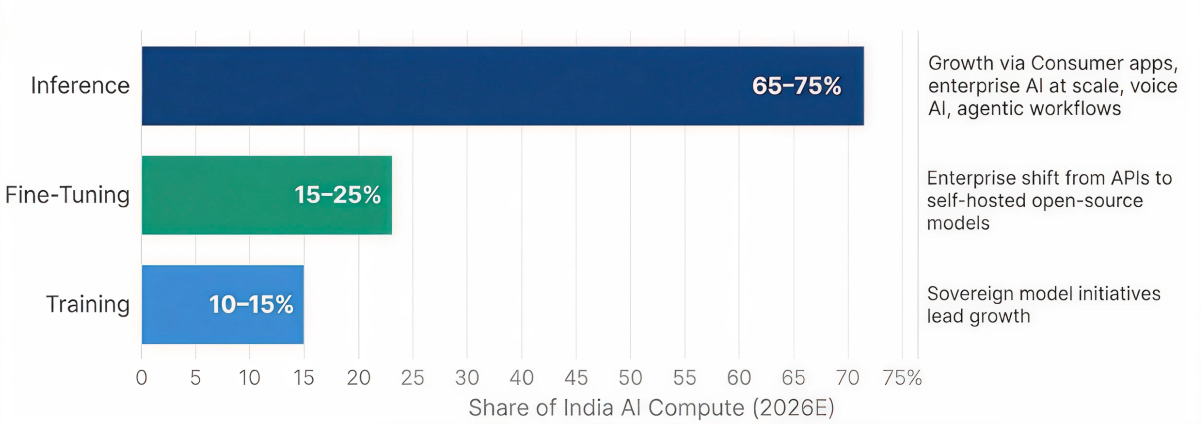
Note: India-specific compute demand data is limited. Estimates are derived from global compute forecasts⁵, enterprise adoption surveys⁹, and inference-heavy usage patterns observed in the Indian market.
Insight 3India's inference demand is shaped by concrete, high-volume use cases moving from pilot to production. The below sections detail few of these high-volume AI use cases relevant for Indian market
3.1Agentic commerce refers to AI-driven transactions where an intelligent agent discovers products, makes decisions, and completes purchases on behalf of a user through a conversational interface. Razorpay, for instance, has launched agentic payments on ChatGPT and Claude, enabling orders from Zomato, Swiggy, and Zepto within a chat interface using UPI Reserve Pay¹¹. With India processing over 14 billion UPI transactions monthly, even a small migration to AI-mediated commerce creates substantial inference demand. This is arguably the most India-specific AI use case in the world: no other country has the combination of a real-time payments rail at UPI's scale and a population already comfortable transacting through chat.
3.2India’s digital payments ecosystem, the world’s largest by transaction volume, is a high-priority target for fraud. AI inference is now central to real-time detection, with models scoring every transaction for anomalies in milliseconds. BFSI accounts for the largest share of India’s AI market13, spanning voice biometrics, anomaly detection, and automated KYC verification, each an always-on inference workload. Unlike a coding assistant that a CTO can defer, a fraud model is a regulatory and financial necessity, making it one of the most durable sources of inference demand.
3.3India’s BPO industry employs over 1.2 million people and serves clients globally. The voice AI agents market is projected to reach $47.5 billion by 2034 at ~35% CAGR14. Players like Gnani.ai (voice cloning across 12 Indian languages), Skit.ai ($28M funded), and SquadStack are deploying AI voice agents at scale6,15. Voice AI is particularly compute-intensive because it combines ASR, NLU, and TTS in real-time with sub-second latency. India’s multilingual context (22 scheduled languages) drives higher model complexity than monolingual markets, and the stack being built here has no Western equivalent, creating a potential export opportunity into other linguistically diverse regions like Southeast Asia and Africa.
3.4India has one of the world’s largest developer populations, and AI coding assistants are seeing rapid enterprise adoption. Infosys, Wipro, and TCS have announced large-scale rollouts across engineering workforces employing hundreds of thousands of developers. 92% of Fortune 500 companies now use ChatGPT16, and much of their offshore development happens in India. The inference demand here is distinct: large context windows (100K+ tokens), fast response times, and high accuracy. For India’s $250 billion IT services industry, built historically on labour arbitrage, AI coding agents are both the biggest threat and the biggest reinvention opportunity.
3.5India’s media and entertainment sector reached Rs 2.78 trillion in 2025. AI-powered image generation, video editing, dubbing, and content personalisation are gaining ground across entertainment, e-commerce, and advertising. Sarvam AI’s Vision model scored 84.3% on olmOCR-Bench, outperforming frontier models on multi-script recognition9. As production costs for high-quality visual content collapse, India’s vast content market will become one of the largest consumers of GPU inference for generation workloads.
India's AI compute demand is real and growing. The country is the second-largest user base for ChatGPT, home to a vibrant startup ecosystem building AI-native products, and host to enterprise adoption shifting from pilot to production. However, the pace of AI adoption depends on three factors:
Economics: Given the price sensitivity of the Indian market, GPU affordability will be a prime driver for adoption velocity and how fast demand scales
Data sovereignty & regulation: The DPDP Act and sector-specific regulations will push more compute to Indian soil, but regulatory clarity is still evolving
Infrastructure readiness: India’s data centre capacity is projected to reach 6.5 GW by 2030 (from ~1.5 GW in 2025), but GPU-ready, liquid-cooled infrastructure remains scarce relative to demand.¹⁷
The demand is not in question. What remains to be seen is whether GPU economics and AI compute supply can reach a level that unlocks the next hundred million users.

22nd October, 2026
The Model and Runtime Boundary Is Shifting
Over the past two years, model architecture has quietly taken over work that once belonged to the serving stack.
22nd October, 2026
How to use Open Weight LLMs - Serverless vs Dedicated Inference: A Practical Guide
Running open weight models like DeepSeek, Kimi, Qwen and GLM gives you a choice: pay per token, or pay per GPU. Which one is cheaper depends on six things.