




Number of open weight models has surged over the past year, with more than twenty 100B-plus models and several 20B plus models released by Moonshot AI, Z.ai, MiniMax, Alibaba, DeepSeek, Meta, Google and others. Their performance is now close enough to frontier closed models that organisations can evaluate open replacements for selected closed-model workloads. In this blog we evaluate how the world is shifting towards open models and how can organisations replace their closed model workload to open models.
Source : https://huggingface.co/blog/state-of-open-models-summer-2026
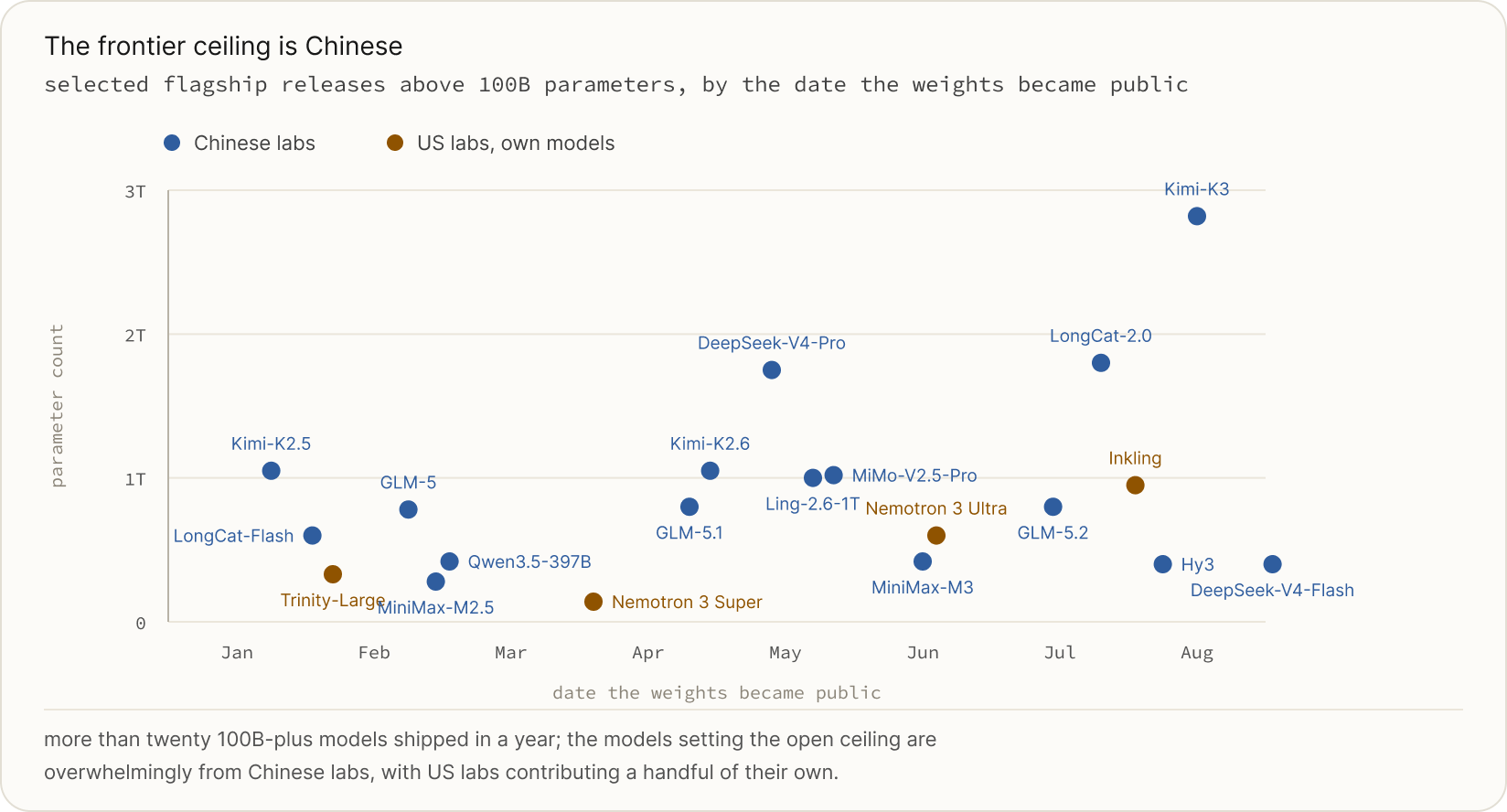
Closed models keep their weights proprietary. You reach them only through the provider's own API. OpenAI's GPT, Anthropic's Claude and Google's Gemini are closed.
Open weight models publish their weights. Anyone can download, host or run them locally. You pay for compute, not for the model. DeepSeek, Qwen, GLM, Llama and Mistral are open.
Open weight models should not be confused with open source models. Open source models are the models where the providers publish the complete training data , scripts and architecture whereas open weight models gives you the finished model file parameters to run keeping the training data and code hidden. For this blog we will be focussing on open weight models.
For closed models, the frontier is Anthropic's Claude Opus 5 and Fable 5.1, OpenAI's GPT-6 Astra and GPT-5.6 family (Sol, Terra, Luna), Meta’s Muse Spark 1.3 and Google's Gemini 3.8 line and xAI’s Grok 4.6.
For open weight models, the leaders are Moonshot's Kimi K3, DeepSeek V4 (Pro and Flash), Z.AI's GLM-5.3 and Alibaba's Qwen3.8.
Below the frontier sits an efficiency tier built around 30 billion parameters, small enough to serve from a single GPU: Google's Gemma 4 31B, Alibaba's Qwen3.8 27B, Meta's Muse Glimmer 30B and NVIDIA's Nemotron 3 Nano at 31.6 billion parameters with 3.6 billion active. These deliver most of the capability at a fraction of the size and cost.
Open weight models compete on every front measured below. We check the open model’s performance compared to closed model on some of the famous benchmarks.
General intelligence
Artificial Analysis combines ten evaluations spanning maths, science, coding and reasoning into a single index.
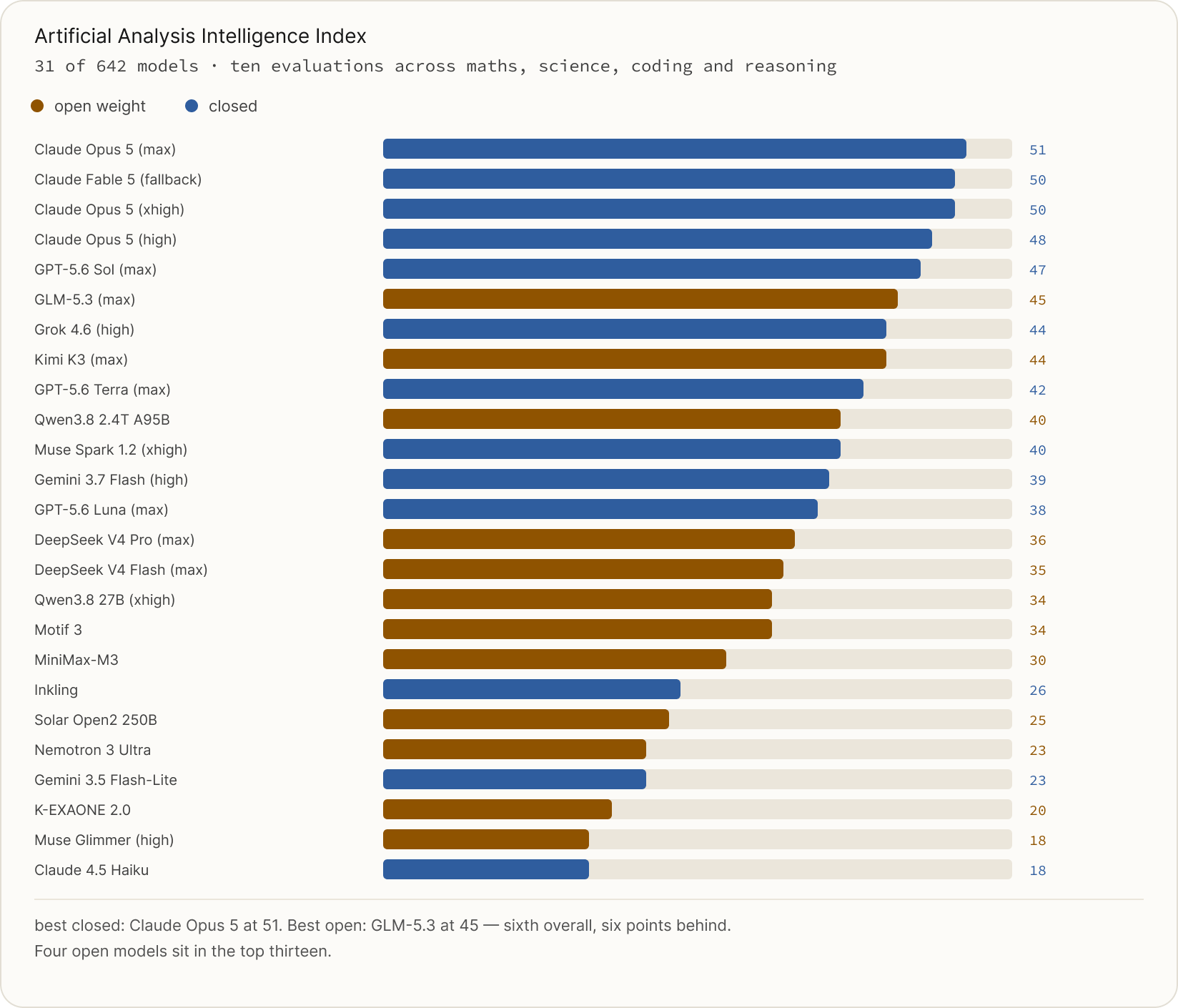
Best closed: Claude Opus 5 (max) at 51.
Best open: GLM-5.3 (max) at 45.
GLM-5.3 arrives in sixth place on intelligence and is 6 points behind Claude Opus 5.
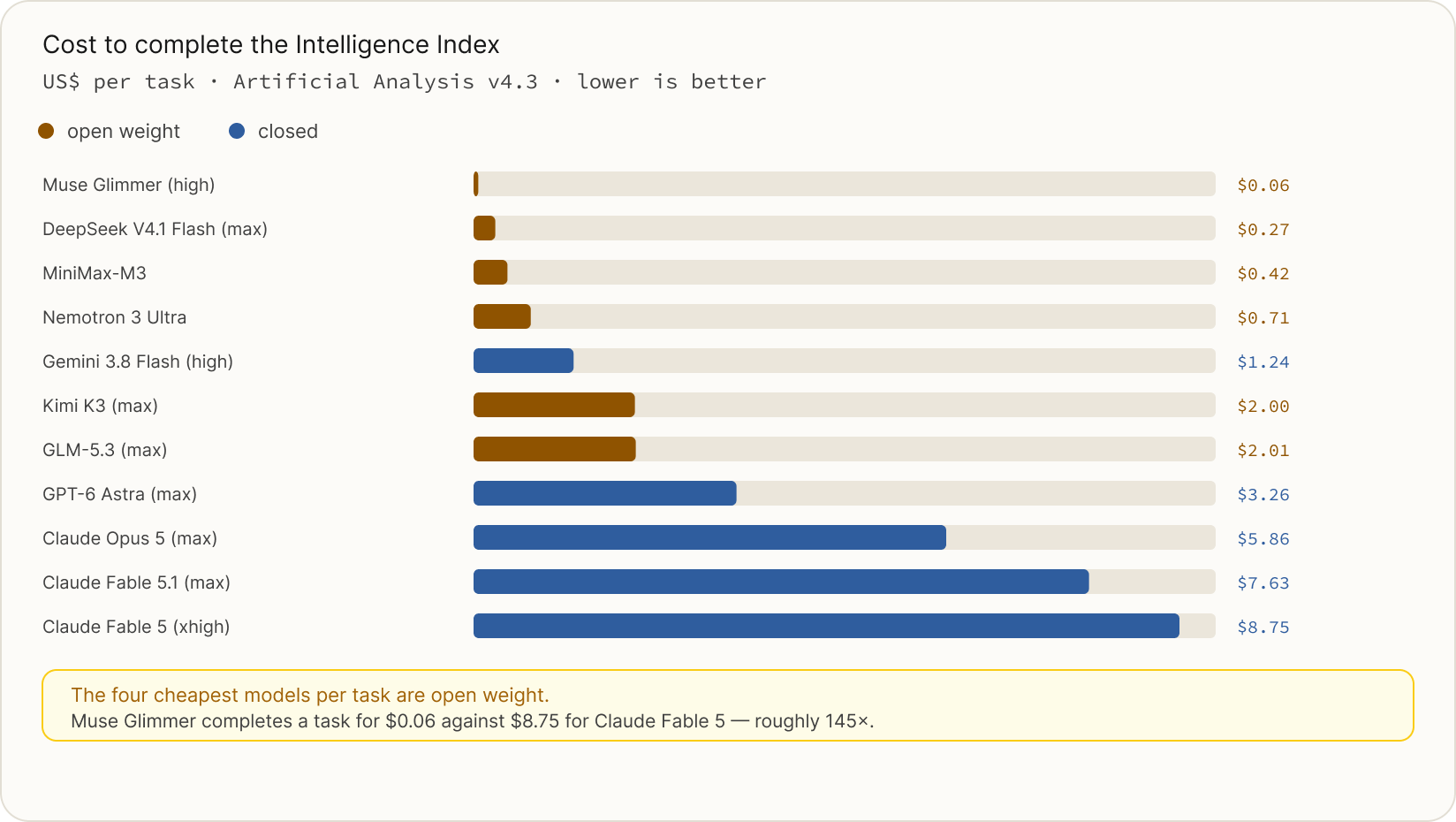
On cost index, the four cheapest models per task are open weight. Muse Glimmer completes a task for $0.06 against $8.75 for Claude Fable 5. GLM-5.3 costs $2.01, roughly a half of Claude Opus 5 and a quarter of Claude Fable 5.
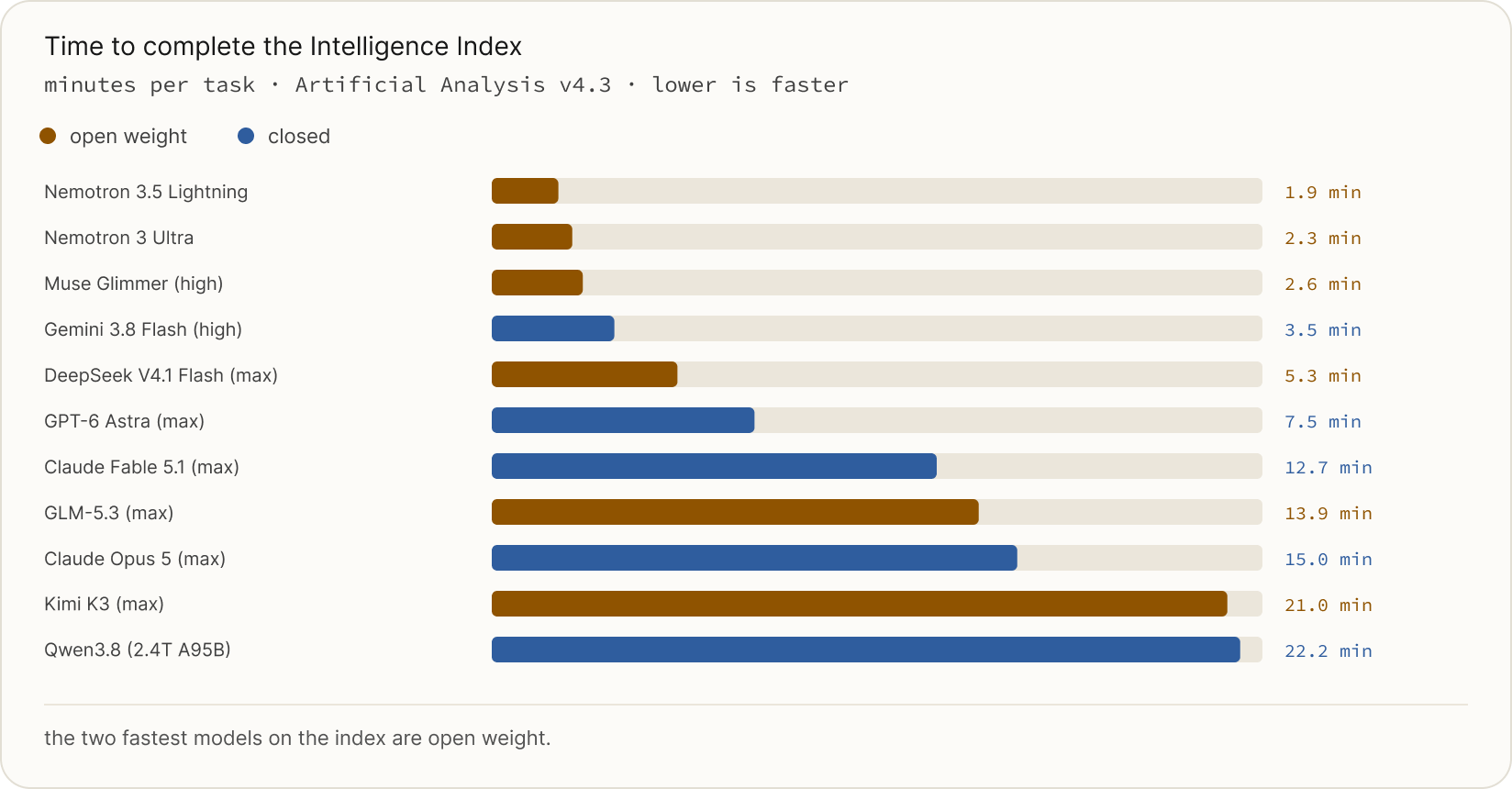
Time per Intelligence Index task, v4.3.
On speed index, the two fastest are open, Nemotron 3.5 lightning at 1.9 minutes and Nemotron 3 ultra at 2.3 minutes.
Graduate level science
GPQA Diamond is the 198 hardest questions from GPQA, covering biology, physics and chemistry.
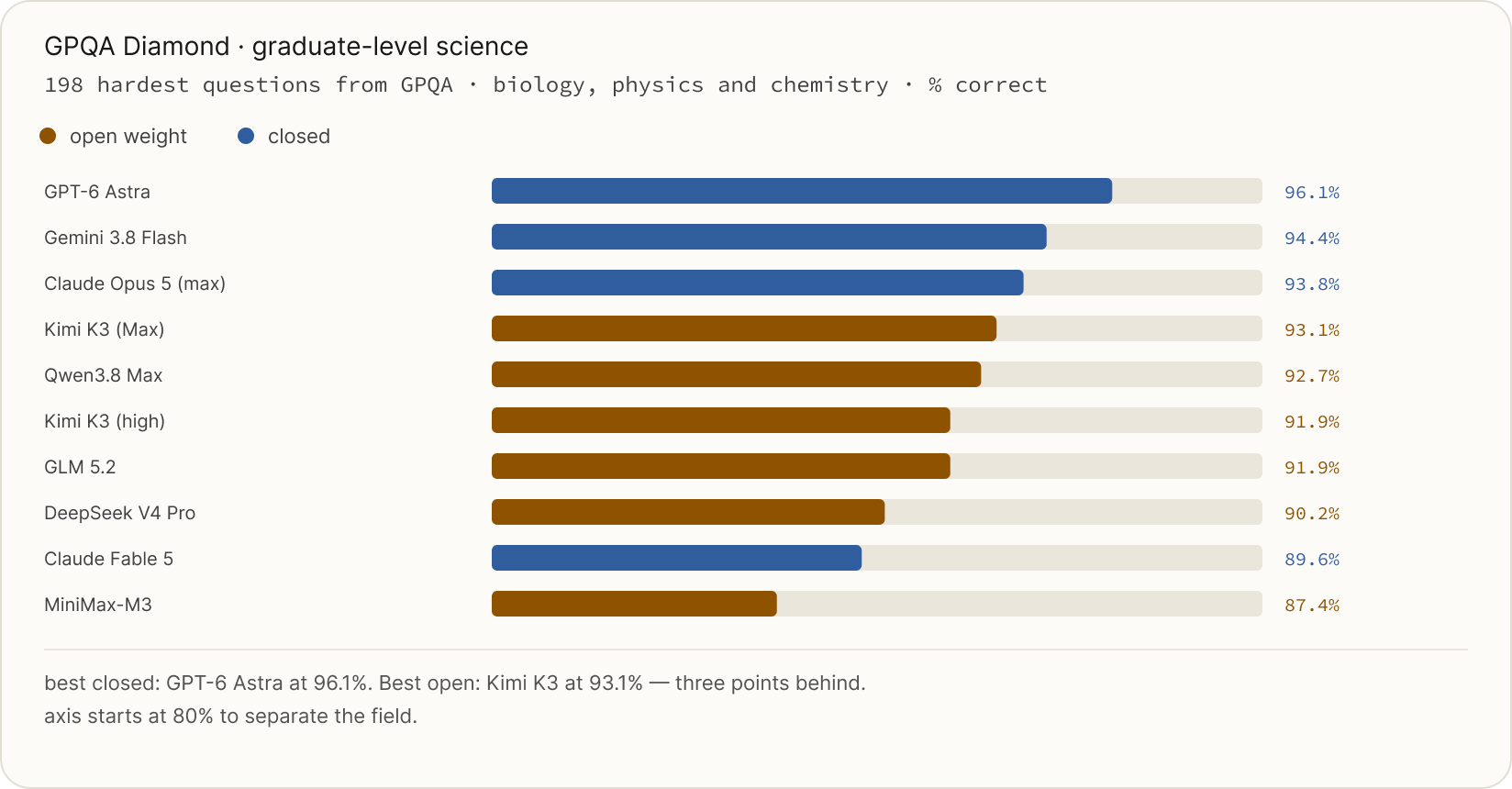
Best closed: GPT-6 Astra at 96.1%.
Best open: Kimi K3 (Max) at 93.1%.
Other models like Qwen 3.8 Max score 92.7%, Kimi k3(high) and GLM 5.2 scores 91.9%.
Long-horizon software engineering
DeepSWE v1.1 is 113 original tasks written from scratch across 91 active open-source repositories in five languages. This is the benchmark that most resembles the work a coding agent is actually given.
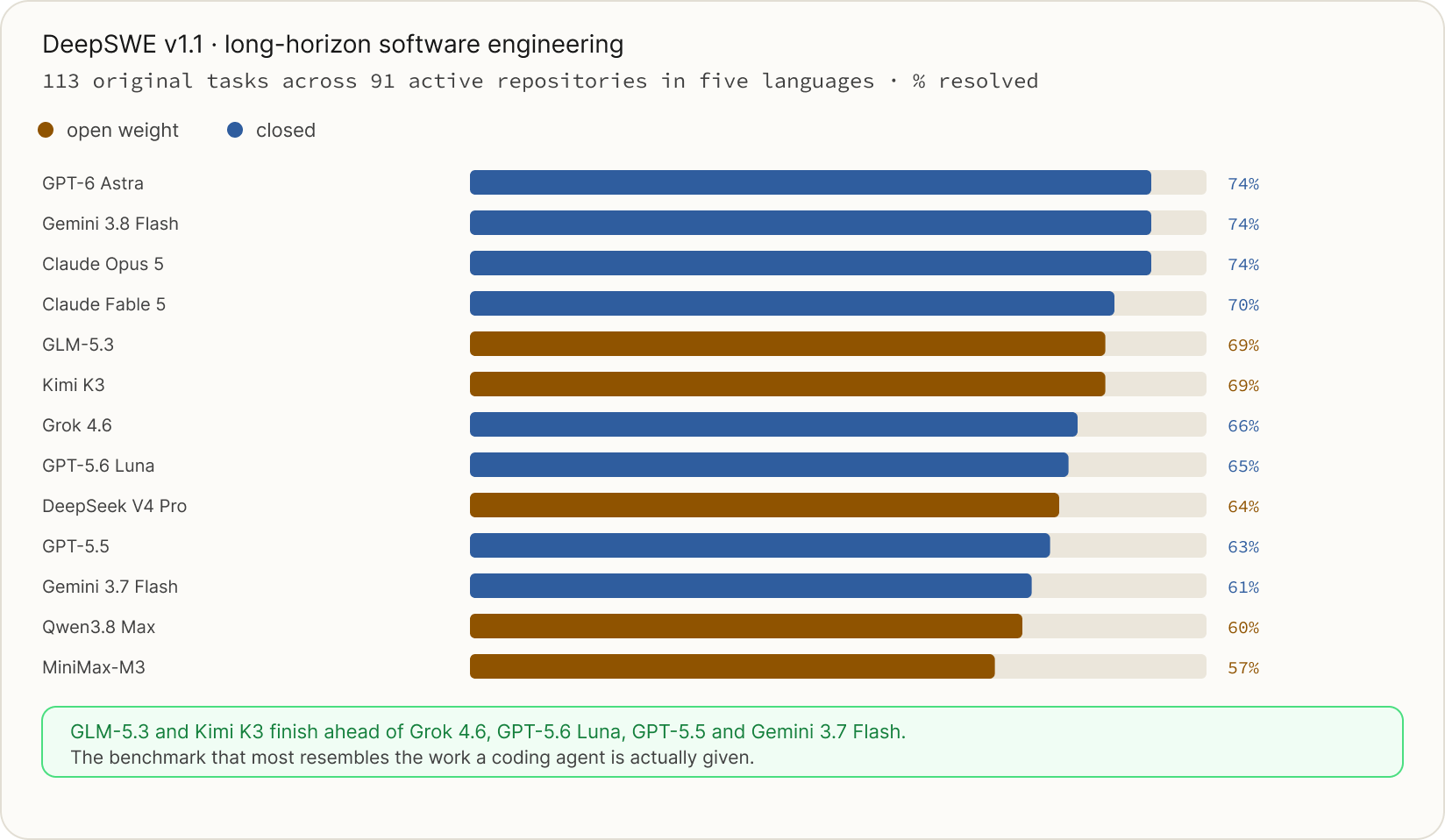
Best closed: GPT-6 Astra at 74%, with Gemini 3.8 Flash and Claude Opus 5 also at 74%.
Best open: GLM-5.3 at 69%, sixth overall, with Kimi K3 level at 69%.
GLM-5.3 sits 5 points behind the leaders and one point behind Claude Fable 5. Four open models sit in the top thirteen. GLM-5.3 and Kimi K3, finish ahead of Grok 4.6, GPT-5.6 Luna, GPT-5.5 and Gemini 3.7 Flash.
From the benchmarks above it is clear that open models are catching up with the frontier models. They are not in the top five for intelligence, coding or science, but they are in the top ten on each, close enough to serve as a replacement for closed models on many workloads. On cost and speed the position reverses. The four cheapest models per task are open, and open models take the top two places on speed. GLM-5.3 leads the intelligence index and DeepSWE. Kimi K3 ties GLM-5.3 on DeepSWE. MiniMax-M3 gives the best science per dollar. Nemotron 3 Ultra gives throughput. Muse Glimmer gives cost and token efficiency. There is no single best open model, so the choice depends on the workload.
Different organisations carry different workloads, and with these many options on both sides the choice is no longer one model for everything. For each of four common workloads, the table below pairs the open pick with its closed equivalent for the reader to make a choice.
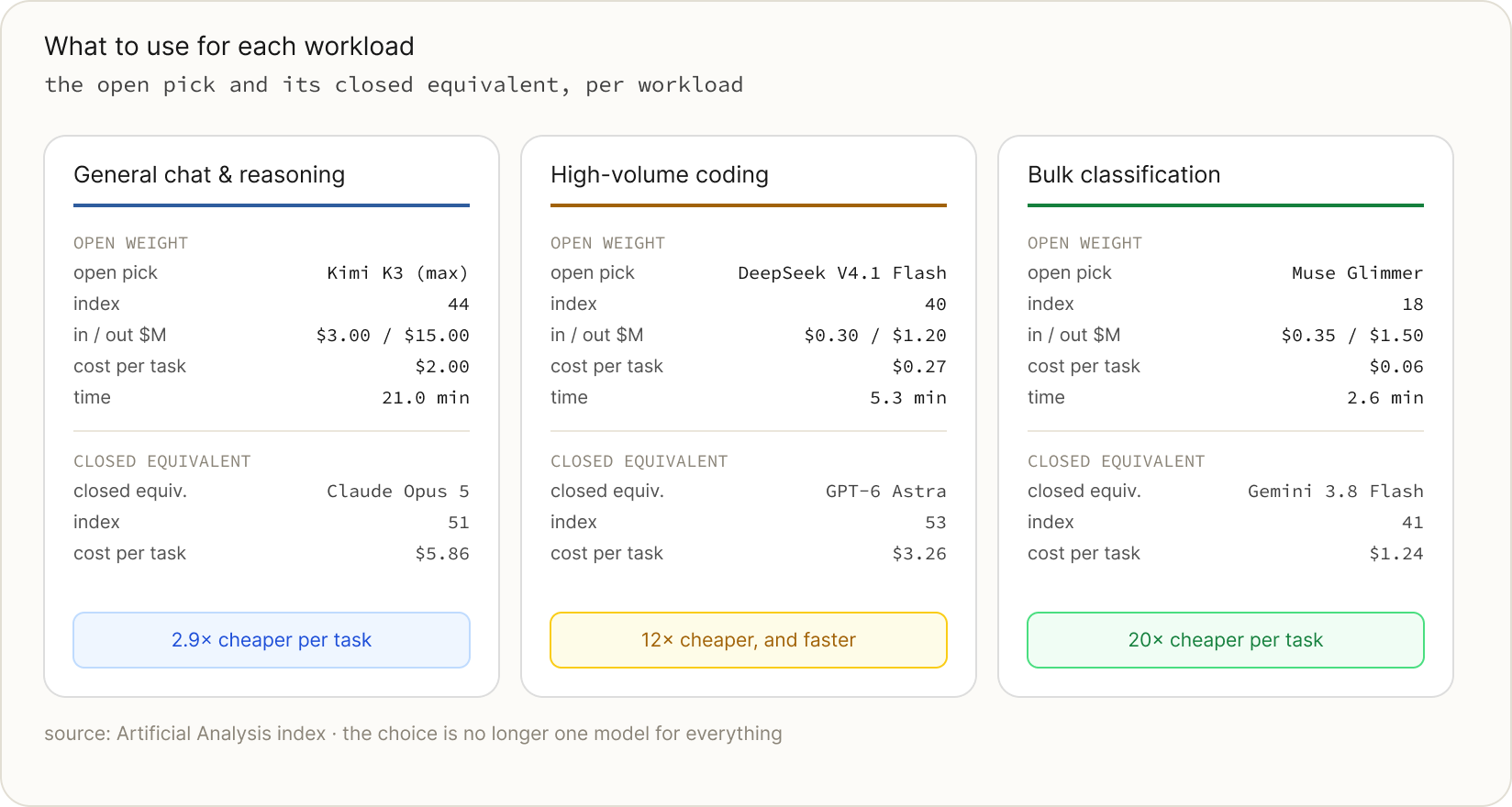
Cost per task / Time per task: Kimi K3 (max) $2.00 / 21.0 min; Claude Opus 5 (max) $5.86 / 15.0 min; DeepSeek V4.1 Flash (max) $0.27 / 5.3 min; GPT-6 Astra (max) $3.26 / 7.5 min; GLM-5.3 (max) $2.01 / 13.9 min; Claude Fable 5.1 (max) $7.63 / 12.7 min; Muse Glimmer (high) $0.06 / 2.6 min; Gemini 3.8 Flash (high) $1.24 / 3.5 min.
Source: Artificial analysis index
OpenRouter
OpenRouter is a unified AI gateway and model routing service that lets developers access over 500 large language models (LLMs) through a single API key and endpoint. A 2025 study from MIT and Georgia Tech analysed OpenRouter data and found closed models took 80% of token usage and over 95% of revenue, even though open models cost about 84% less and matched frontier capability within 3 to 6 months of each release.
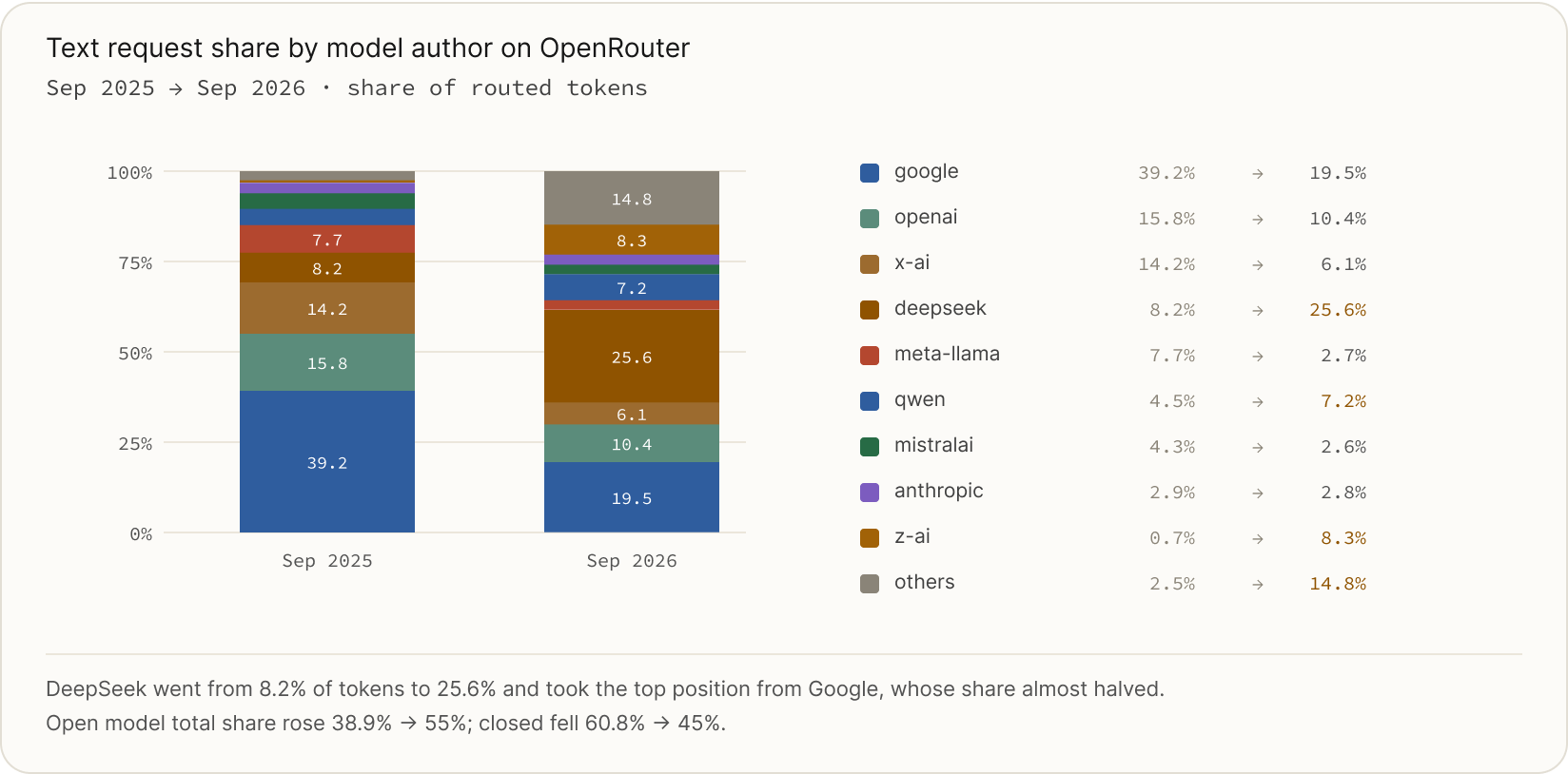
Over twelve months the order inverted. DeepSeek went from 8.2% of tokens to 25.6% and took the top position from Google, whose share almost halved from 39.2% to 19.5%. Open model total share on OpenRouter increased from 38.9% to 55% and that of closed models decreased from 60.8% to 45%
Open models providers hold six of the top ten places on OpenRouter.
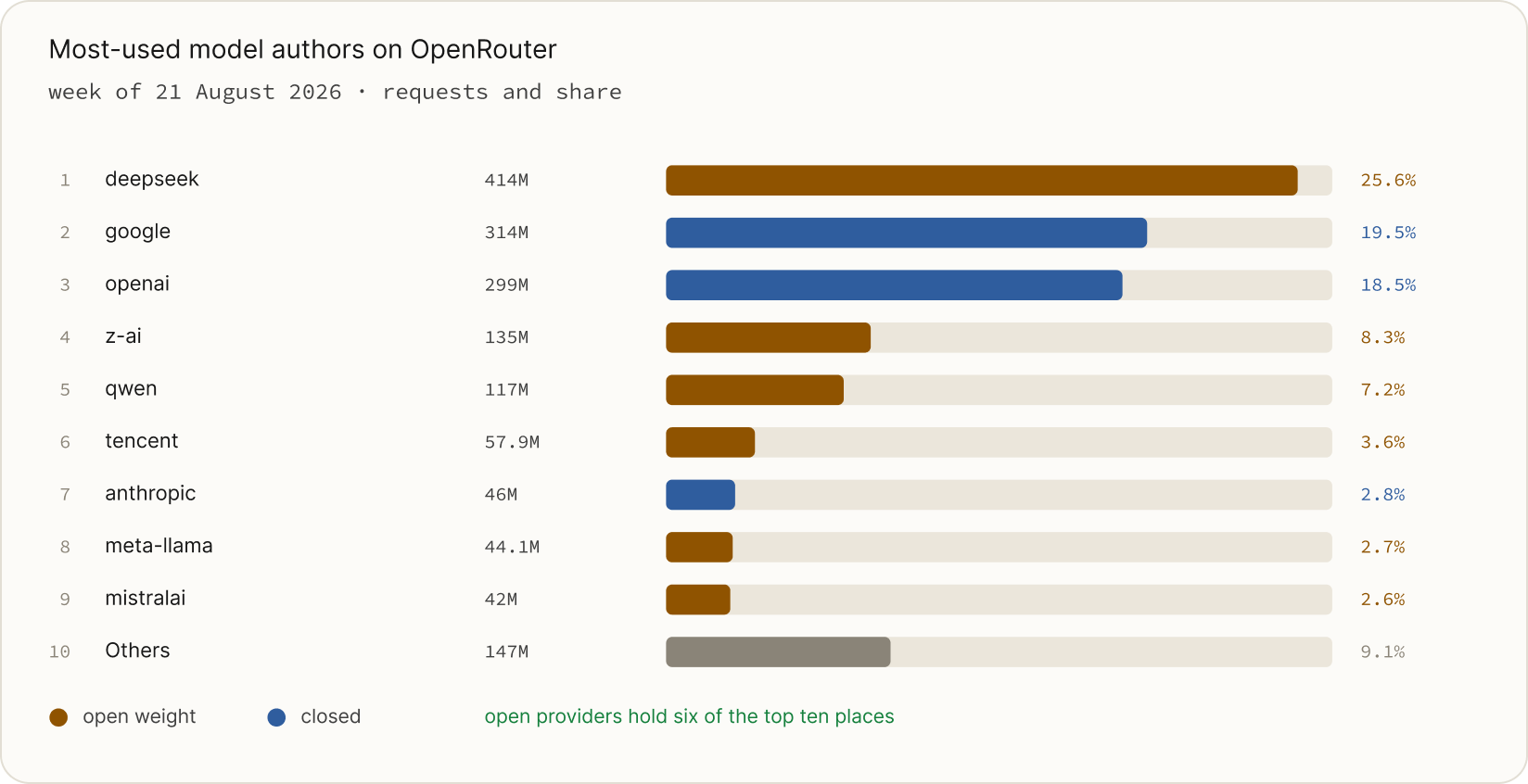
Most-used models on OpenRouter, week of 21 August 2026.
Between late May and Sep 2026 OpenRouter’s daily volumes rose sharply, and the reason can be attributed to cluster of releases: MiniMax M3 in June, Kimi K3 in July, DeepSeek V4 Flash and DeepSeek V4 Pro variants between May-Aug, Muse Glimmer on 10 August and GLM-5.x versions in June and August.
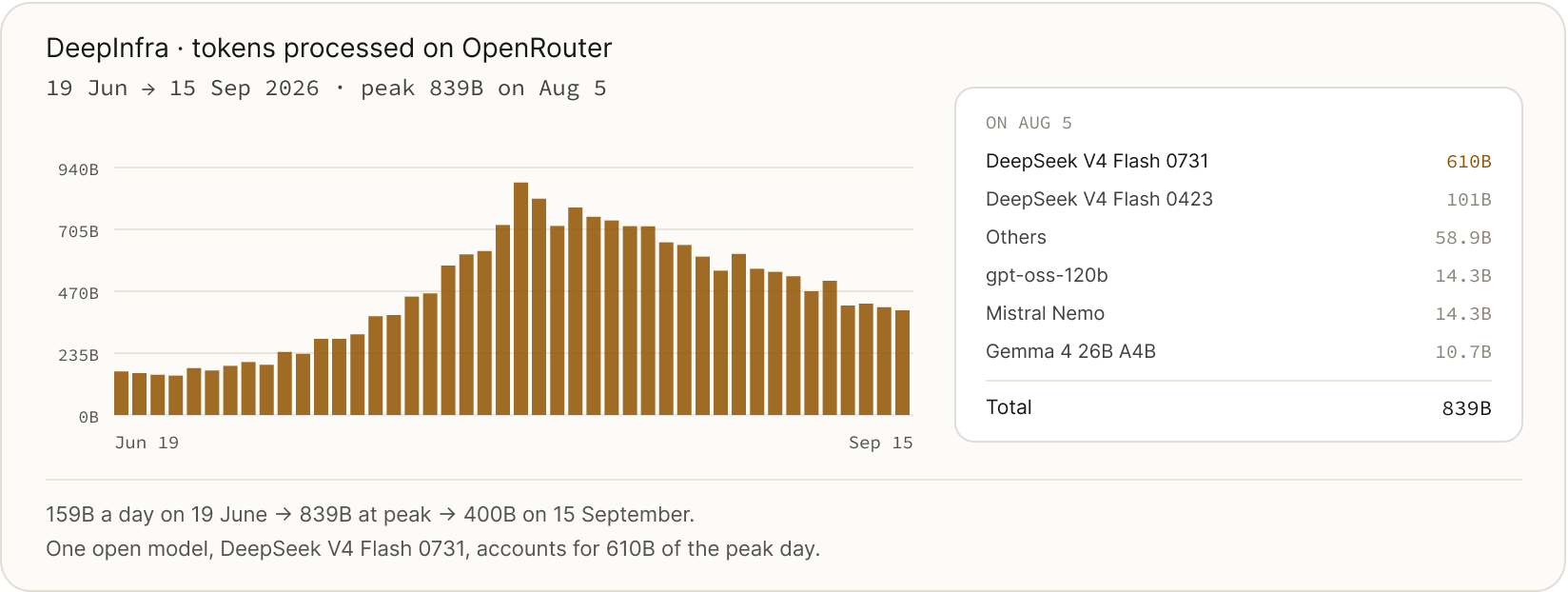
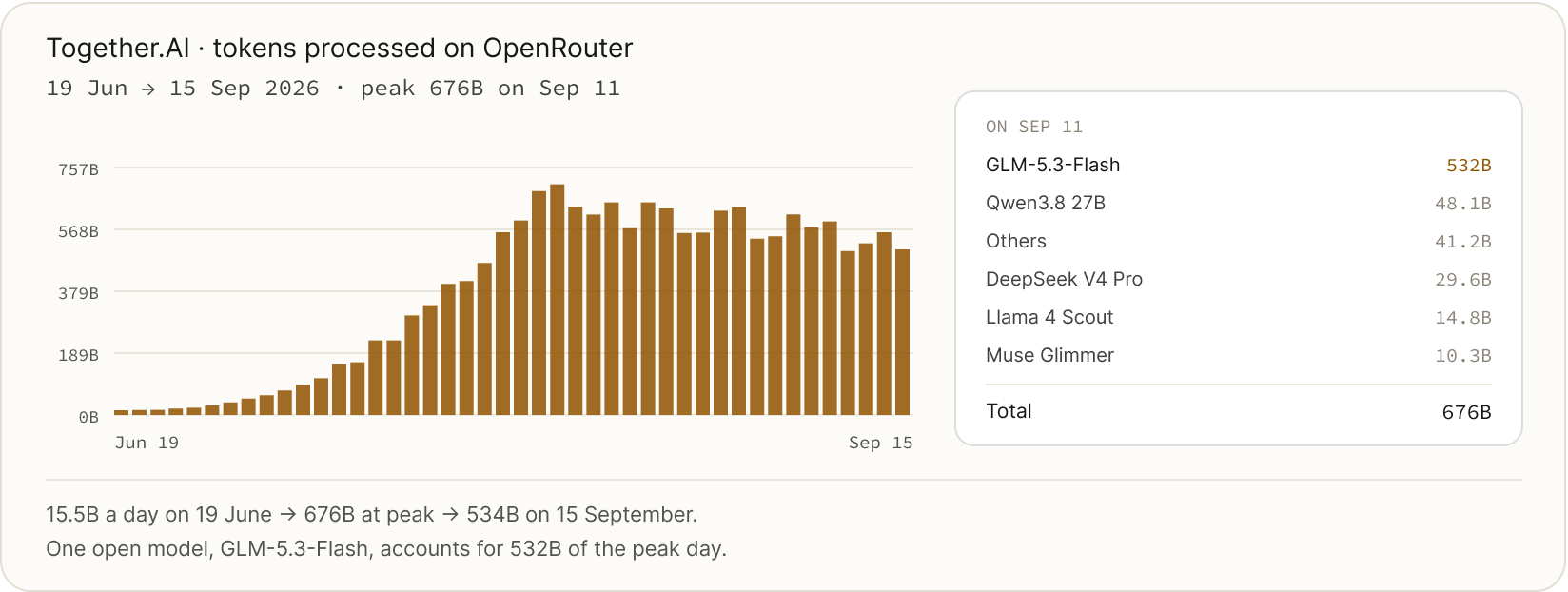
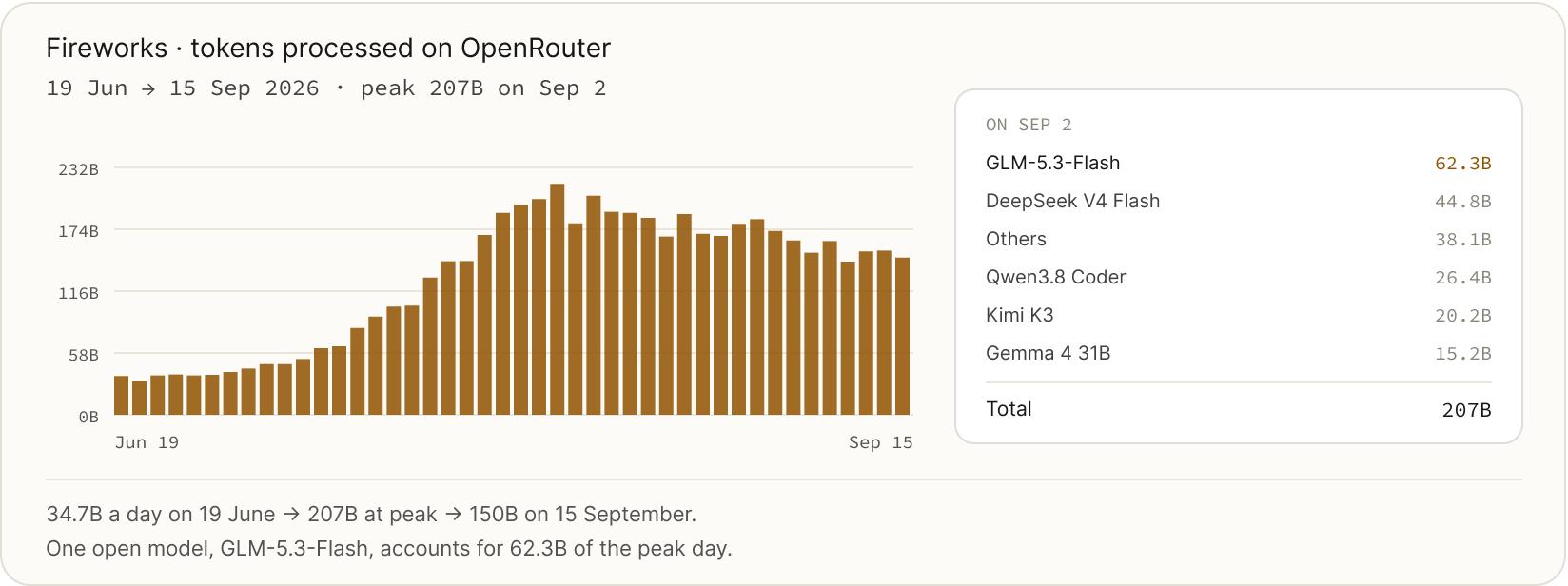
Provider volumes grew sharply over the summer. DeepInfra went from 159 billion tokens a day on 19 June to 839 billion on 5 August and 400 billion on 15 September. Together.AI went from 15.5 billion on 19 June to 676 billion on 11 September and 534 billion on 15 September. Fireworks went from 34.7 billion on 19 June to 207 billion on 2 September and 150 billion on 15 September.
A single open model accounts for most of each peak. Of the 839 billion tokens DeepInfra served on 5 August, 711 billion went to DeepSeek V4 Flash, 85% of that day's volume. Of Together.AI's 676 billion on 11 September, 532 billion went to GLM-5.3-Flash, 78.6%. On Fireworks, 62.3 billion of 207 billion went to GLM-5.3-Flash.
OpenCode
OpenCode runs agentic coding, which is long-running, expensive and the most demanding category to hand an open model. Two of three and seven of ten most used models are open weight models.
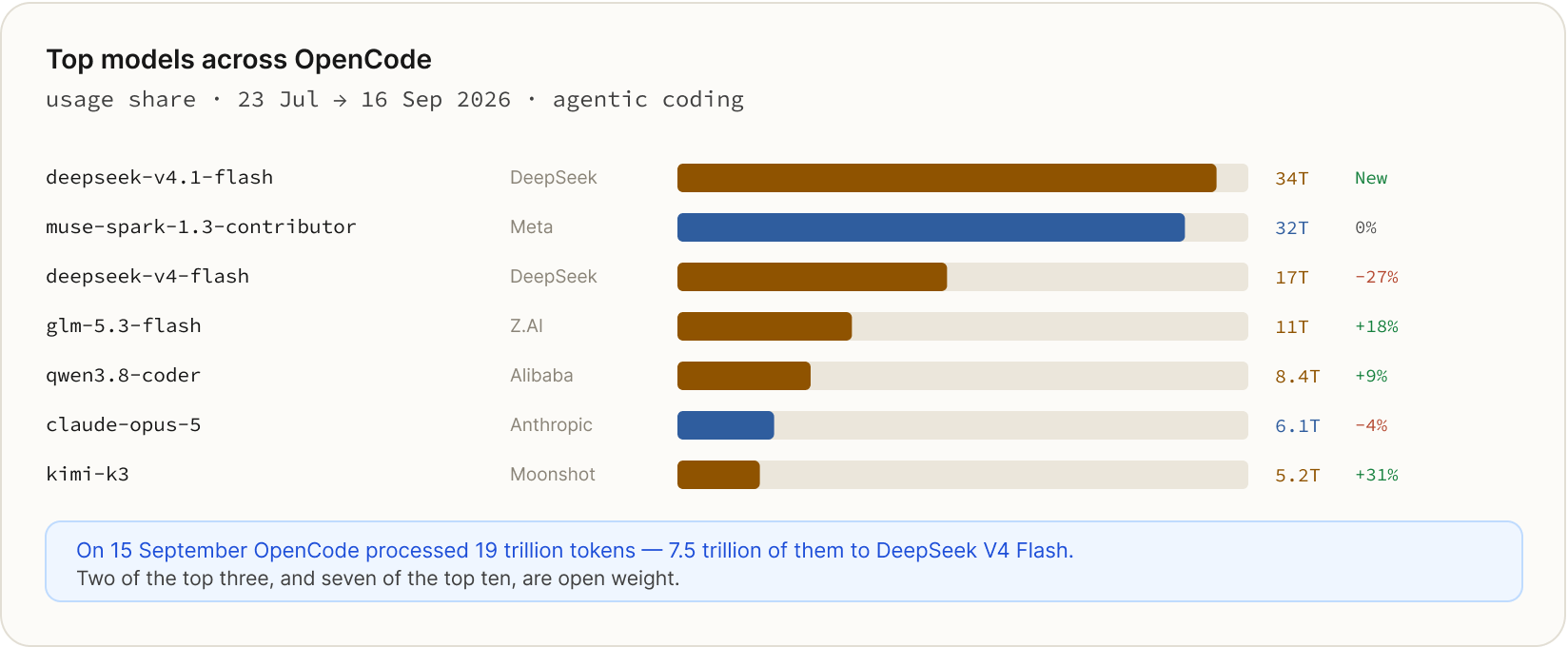
On Sep 15, OpenCode processed 19 trillion tokens, 7.5 trillion went to DeepSeek V4 Flash.
Hugging Face
Hugging face lets inference providers serve their request through their platform. In Aug-Sep Together.AI served 26 M request, DeepInfra served 11.6 M, Novita AI which served 7.4 M requests and Fireworks served 5.2 M.
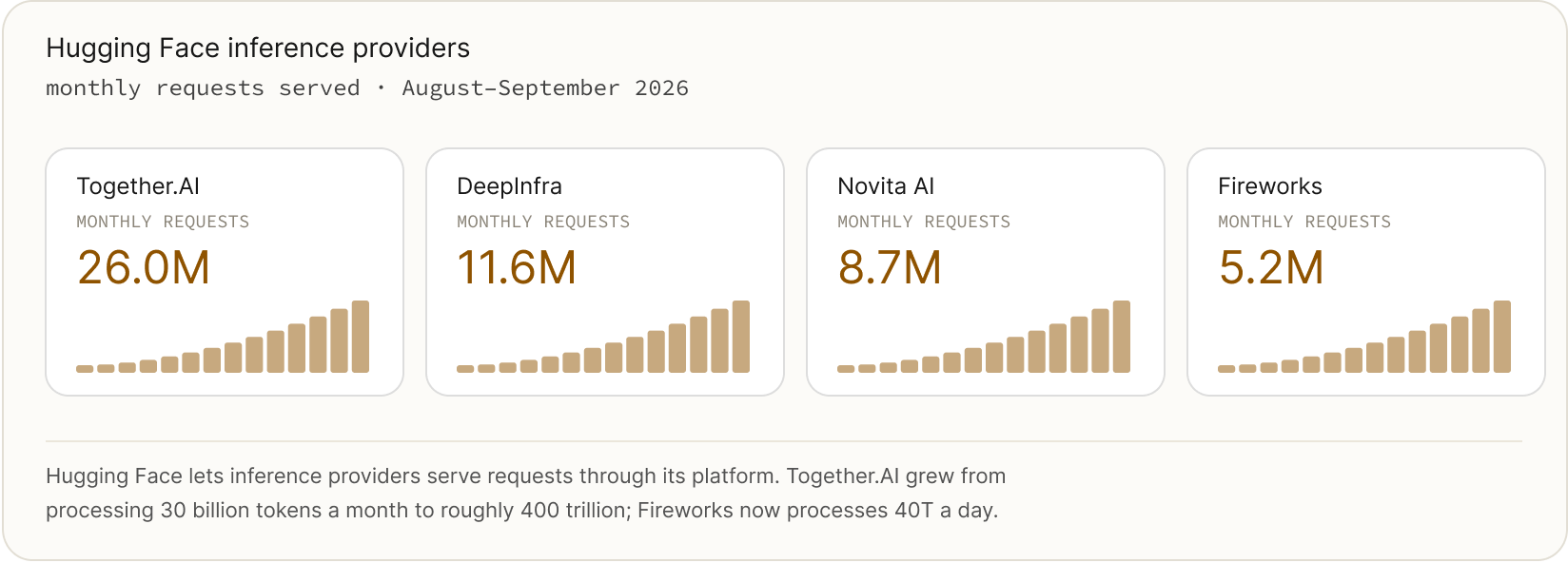
Requests served in August 2026, Hugging Face inference provider statistics.
The above data shows that in 2026, the demand for open models is largely increasing. Together AI grew from processing 30 billion tokens a month to roughly 400 trillion. Fireworks processes 40T tokens in a day.
Open models are a strong fit for:
High-volume, repetitive workloads where cost dominates. Bulk code generation, classification, summarisation at scale, agent loops making many calls.
Data residency, privacy or compliance constraints. Open weights run in your own VPC, on premise, or in a specific region.
Teams that need to fine-tune or pin a version. You control the weights, so no surprise deprecations and no silent model updates changing outputs.
Startups where unit economics matter. Inference is often the largest variable cost in an AI product.
Open models are nearing the intelligence of frontier models. The 30 billion parameter models are even better at cost efficiency and the number of tokens used. The big open models are in the top ten for many benchmarks. But these are all tested on other datasets, so an organisation should also evaluate how an open model will perform on its own data. For that, the next post will cover how to create a golden dataset, how to evaluate open and closed models against it, and the different ways an organisation can move a workload from closed to open.

 22nd October, 2026