

TheNextDecadeofAI:
FromFormtoFlow
ThefirstphaseofAIwasaboutForm:biggermodels,biggerdata-centres,biggerclusters.ThenextphaseisaboutFlow:howfastthatintelligencemoves,howsafelyitruns,andhoweasilyitreachesthepeoplewhoneedit.
 6th April, 20268 Min Read


The last two years in the AI community have been nothing short of a miracle. Together, we have built what we like to call the "Monoliths of Intelligence" those massive, awe-inspiring AI models and cloud clusters that proved super-intelligence is not just a dream from a sci-fi novel; it is a reality we have reached.
As we start moving these models out of the lab and into the places where they matter most—our hospitals, our schools, and our neighbourhood banks, we are realising something important. It is not that the AI is not smart enough; it is that the cloud infrastructure it lives on has not caught up yet.
The first phase of AI was about Form: bigger models, bigger data-centres, bigger clusters. The next phase is about Flow: how fast that intelligence moves, how safely it runs, and how easily it reaches the people who need it.
The Numbers That Define This Moment
The scale of what we have built is staggering — and so is the gap between where we are and where we need to go. Three numbers tell the story of why the cloud must change.
These numbers reveal a fundamental tension. AI models have grown exponentially in capability, and the cloud market is expanding to match the demand. Yet fewer than 3% of enterprises feel their infrastructure is truly ready. The models are getting smarter every month — but the cloud they run on is not getting more fluid. That gap is what we are here to close.
1,000,000x
Model Parameter Growth
Growth in AI model parameters from BERT (2018) to frontier models (2025)
$2.3T
Projected Cloud Market
Projected global cloud market by 2032, up from ~$0.6T in 2022
<3%
Fully Satisfied Enterprises
Of enterprises report being "fully satisfied" with AI infrastructure reliability today
So, if models are getting smarter every month, why isn't the cloud getting more fluid, too?
We believe the next decade won't be defined by how big your AI is. It will be defined by how well it flows. We are hard at work building Nava—our AI-native cloud platform—and we would love to share the simple ideas that keep us inspired every day.
The "UPI Moment" for the Cloud
To understand "Flow," look at how we move money. Before UPI, moving money felt heavy. Your money was locked inside your bank's specific system. Sending it to someone else felt like a "process" rather than a click. UPI changed the game by separating the Store from the Movement: the Bank became the Vault (the secure place where money sits), and the App became the Flow (the instant way money moves).
The scale of this shift was staggering - UPI went from 1 billion transactions in its first full year to over 131 billion in FY2024, processing more than ₹200 trillion in value. Cloud computing is about to have its UPI moment.
Today, using AI infrastructure feels like being a mechanic. You must pick machines, configure clusters, move data, and manage capacity. It works, but it is clunky. At Nava, our goal is to turn hardware into the "Vault" and compute into the "Flow."
Analogy
Bank = Vault
Secure, stable, always available — the foundation that holds everything.
App = Flow
Instant, frictionless, intent-driven — the experience that delivers value.
Nava = Both
Hardware as the Vault. Compute as the Flow. One unified system.
The Traditional Way vs. The Nava Way
The difference between today's cloud and what we are building at Nava is not incremental, it is a complete reimagining of how infrastructure should work. Every dimension of the experience changes when you design for Flow from the ground up.
From rigid boxes to elastic pools, from manual provisioning to automatic flow, from bolted-on security to security in the DNA - every row in this table represents a fundamental shift in how infrastructure behaves. The result is a system where developers stop being mechanics and start being drivers, declaring what they want and letting the system figure out the how.
Our 3 simple rules for "Flow"
Building a new kind of cloud from the ground up is a big mountain to climb. To keep our compass pointed in the right direction, we follow three simple rules.
Rule 1The Highway is as Important as the Car
AI does not live on just one chip; it lives across thousands. The speed of your system is not about one fast GPU anymore — it is about how fast those GPUs talk to each other. NVIDIA's NVLink 4.0 delivers 900 GB/s of bidirectional bandwidth per GPU, versus 128 GB/s on PCIe 5.0 — a 7x gap that makes the network, not the chip, the real bottleneck. We design the network to be the centre of the system, so thousands of machines act like one single mind.
900 GB/s
NVLink 4.0 bidirectional bandwidth per GPU
128 GB/s
PCIe 5.0 bandwidth — the legacy road that creates the bottleneck.
7× Gap
The real performance bottleneck in AI systems.
When thousands of GPUs must work together as one, the interconnect between them becomes the defining factor in system performance. A 7x bandwidth gap means that even the most powerful individual GPU will be starved for data if the network cannot keep up. At Nava, we design the network to be the centre of the system — not an afterthought — so that thousands of machines act like one single mind.
Rule 2Move the Brain, Not the Mountain
Moving massive datasets is slow and risky. The average enterprise data breach involving a cloud migration costs $4.45 million(IBM, 2023). We think it is much better to move the AI to the data. We are designing a system where the AI can "teleport" to where your information lives — so your personal data stays exactly where it belongs while the AI learns how to help you. In regulated sectors like healthcare and finance, this is not a feature; it is a legal necessity.
Rule 3Safety That's Second Nature
In a world full of personal information, security should not be an "extra" feature. 82% of data breaches in 2023 involved data stored in the cloud (Verizon DBIR). We are building safety directly into the cloud's foundation, using confidential computing approaches — such as hardware-level memory encryption via Trusted Execution Environments (TEEs) — to ensure your data stays encrypted even while it is being processed. Privacy becomes a natural part of how everything works, not a checkbox.
Atlas & Vedas: A system with a map and a memory
Modern cloud systems can sometimes be "blind." A 2024 Gartner study found that the Mean time to detect (MTTD) a cloud infrastructure incident is still 197 minutes, over three hours of flying blind. They might tell you something is wrong, but they rarely have the context to tell you why.
Atlas - The Map
We are developing Atlas, a complete topology map of our entire cloud—from physical wires to running workloads. If things slow down, we do not have to guess; we just follow the map. Think of it as a real-time knowledge graph of every dependency, updated continuously, so root-cause analysis takes seconds, not hours.
Vedas - The Memory
Vedas is like a digital institutional memory that "remembers" how problems were solved in the past. Once a resolution is encoded, it propagates across the entire fleet, ensuring that once we solve a challenge, it stays solved for everyone, forever. Mean time to resolve (MTTR) becomes a ratchet that only moves in one direction.
From "Mechanic" to "Driver"
Today, running AI feels like being an engine mechanic. You are constantly tuning, scripting, and fixing. A McKinsey survey found that infrastructure teams spend up to 40% of their time on configuration and maintenance tasks that add no business value. We believe the future should feel like being the driver. We call this Intent-Based Execution.
Intent-Based Execution
You say the goal, Nava figures out the how.
You tell the cloud what you want. The cloud figures out how to do it. This is not science fiction—it is the logical endpoint of a decade of advances in AIOps, policy-as-code, and eBPF-level telemetry. We are wiring all of it together.
Keep this model fast
Auto-scales replicas, pins hot layers in HBM, reroutes to lowest-latency PoP
Keep this data in my region
Enforces data residency at network fabric level, blocks cross-border replication
Don't spend more than X
Downsamples to spot instances, defers batch jobs, surfaces savings recommendations
Intent-Based Execution is the culmination of everything we have described: elastic pools that auto-breathe with load, Atlas maps that enable instant root-cause analysis, Vedas memory that self-heals the system, and security built into the DNA of every transaction. You declare what you want, and the system executes — automatically, securely, and at the speed that modern AI demands.
NAVA - Initialize Fabric
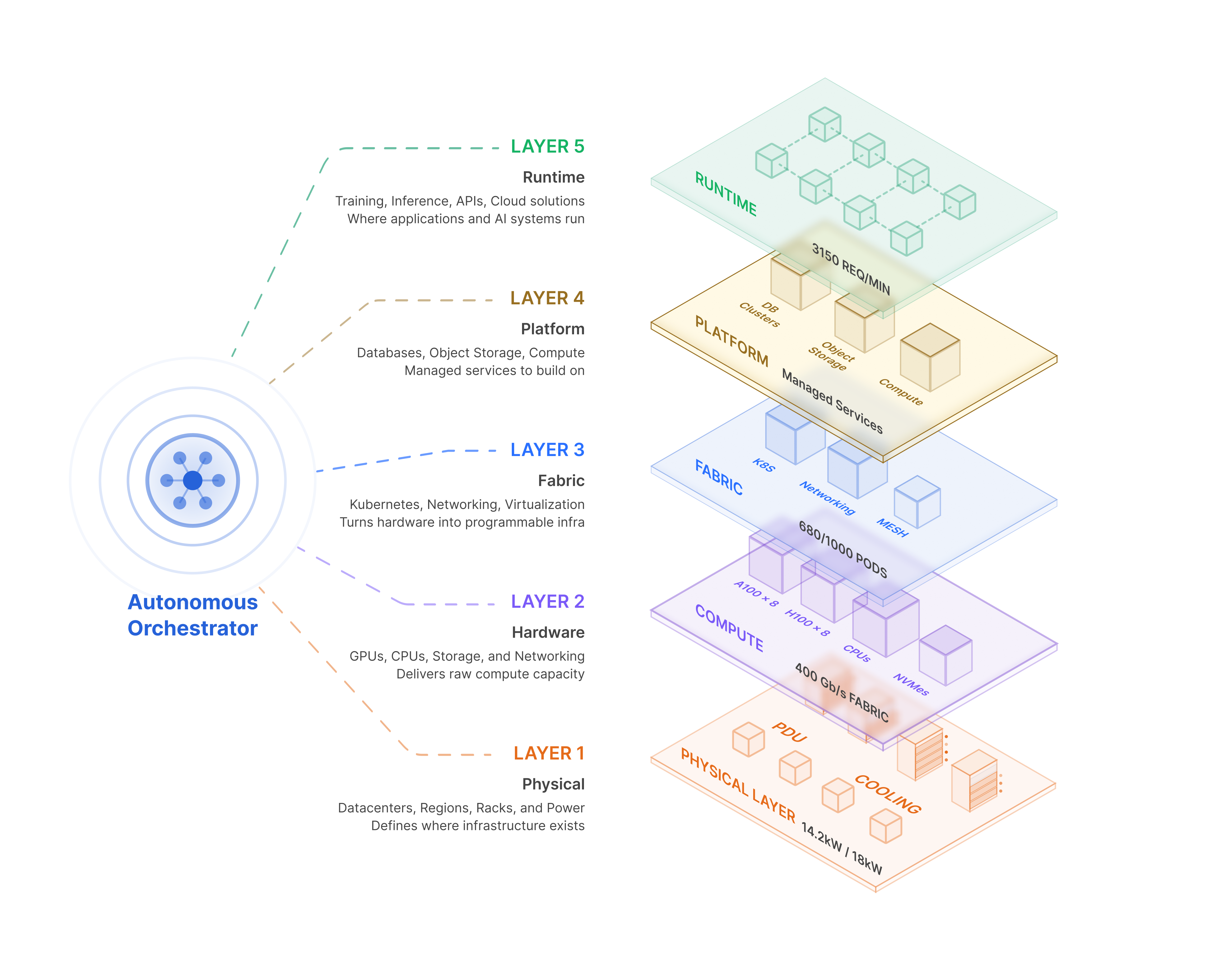
The future of cloud — autonomous, secure, and AI-native. Deploy open-source and proprietary models via managed APIs, run private LLMs on dedicated infrastructure, and access raw GPU capacity exactly how your workload demands it.
We are hard at work building Nava — our AI-native cloud platform — and we would love to share the simple ideas that keep us inspired every day.
Latest blog posts
Tool and strategies modern teams need to help their companies grow.